Remedy 05 · The Apothecary

I want to go deeper.

For the practitioner ready to move past stress relief.

There comes a point when meditation stops being a coping tool and starts being a question. Who is doing the breathing? What is left when the thoughts settle? These three practices are doors. They are not for fixing — they are for finding out.

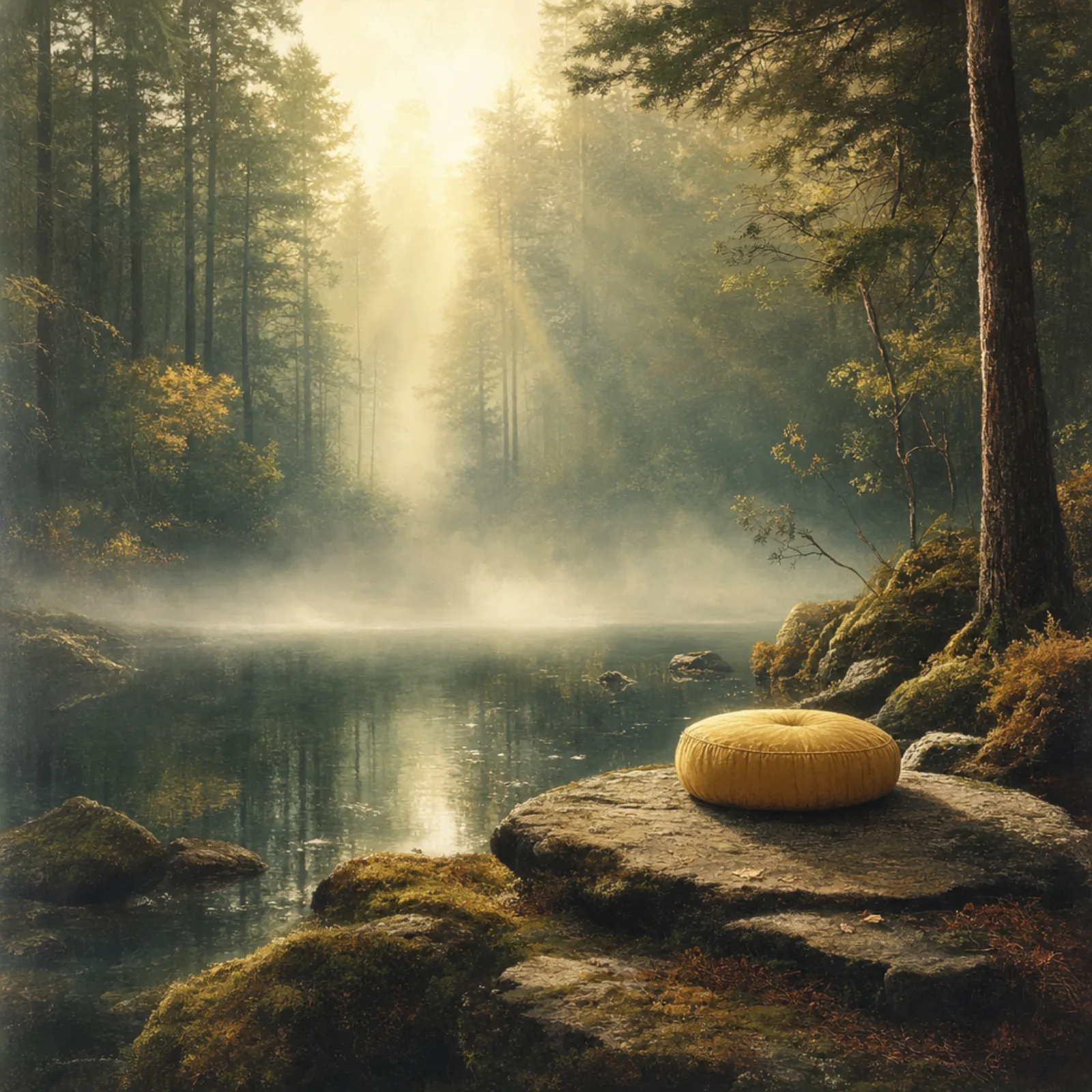
A still, dark forest pool at first light, mist hovering above the surface, a single round meditation cushion on a flat rock at the water's edge.

How this shows up

The ten-minute app session has started to feel a little thin. You sense there is more here, but you don't yet know what it is or how to look for it.

You can quiet the surface of the mind well enough now — but underneath, there are questions you have been politely not asking yourself for a while.

You are curious about the traditions the techniques came from — not in an academic way, but in the way a body becomes curious about its own home.

You want a practice that does not promise to make you better at being busy — but that helps you remember why being busy is something you chose, or perhaps no longer choose.

What it's signalling

The wish to go deeper is a sign the surface practice has done its job. Your nervous system has settled enough to notice that there is more here than calm. There is also truth, and it tends to live a layer or two below the breath.

Going deeper is not necessarily going further away. It is going more honestly into what is already here. The deeper practices simply ask: instead of using meditation to feel better, can you use it to see clearly — and then let what you see change you?

Three practices

For seeing clearly

Vipassana Basics

"Insight" meditation. Not concentration on a single point but a wide, even attention to whatever arises — sensation, thought, sound — without clinging to it or pushing it away.

  1. Sit upright, comfortable but alert. Set a timer for 20 minutes.
  2. Anchor first in the breath at the nostrils — sensation, not idea.
  3. When the mind moves, simply note: thinking, hearing, feeling. Then release.
  4. Watch how every sensation arises and passes. Nothing stays. This is the teaching.
  5. End not with a victory, but with a small, useful humility about how the mind works.
For settling the busy mind

Mantra Meditation

A single word or phrase, silently repeated, given to the mind as something to hold instead of the usual five thousand things. The mantra becomes the railing, not the destination.

  1. Choose a single short word or phrase — so·hum, peace, let·go, your own.
  2. Sit comfortably. Eyes closed.
  3. Silently repeat the mantra, gently linked to the breath if helpful.
  4. When the mind drifts — and it will — return to the mantra without scolding yourself.
  5. After 20 minutes, sit for a moment in the quiet that follows. That quiet is the practice.
For asking real questions

Contemplative Inquiry

A meditation built around a single, honest question, held over time. You don't answer it — you let it answer you. A practice borrowed from both Zen and the Christian contemplatives.

  1. Choose one question that genuinely matters to you. What am I avoiding? What am I being asked to grow toward?
  2. Sit, settle, and silently ask the question once.
  3. Don't solve it. Don't even think about it. Just keep it in the room with you.
  4. Whenever the mind drifts, return to the question, like striking a soft bell.
  5. Over days, not minutes, the answer will start arriving sideways — in walks, dreams, small choices.

Sit with Aparna