Listen to this note
We sat in the hospital waiting room for hours while the formalities were completed. Arms extended to each other, huddled together, shoulders slumped. Sometimes the body shaking with violent crying, other times silent tears just flowing like rivers while a sense of the whole thing being unreal settled over everybody.
The witness watched me mourn the loss of my mother. Sometimes the breath was shallow and caught in a way that felt like I was suffocating, and then it opened up and became spacious. A hollow sat in the pit of my stomach, the kind that makes you feel you want to throw up all the time. Tight hot bands across the chest like being tied down and unable to move. Other times I was floating on air and none of it had happened at all.
I could not decide then, and cannot now, whether to be grateful for that. There is a version of this where years on the cushion gave me the capacity to stay present to something otherwise unbearable. There is another version where they gave me a seat at the back of the room, a comfortable distance from my own mother's death, and let me call it equanimity. I did not want to be the woman observing her grief with interest. I wanted to be flattened by it, the way you are supposed to be.
The mind played its usual tricks alongside. There was a sense of being in a dream, that she would simply walk back in. Then that she had been gone so long it was as though she had never been there. Then the fear that I was forgetting her, that I could not bring up what she looked and sounded like in my mind's eye. Then the guilt when I laughed at something, because how could I be so normal in the face of such a tragedy? Through all of its shenanigans, though, something underneath kept saying I was going to be fine. When the dust settled and I had found acceptance for the loss, I would be alright, and I would remember her from her happy and healthy days.
The rituals came one after another. Arrangements for the funeral, poojas at home, the prayer meeting. There was not much room to grieve privately, because it was being done publicly, by a host of people who love and care for us enough to be there at such a time. Friends and family who had already been through it. Some who were honest enough to say they could not fathom what I was going through. And then the others, with their platitudes of don't cry and be strong.
Be strong. As instructions go it is remarkably unhelpful, since nobody tells you what strong is meant to look like at your mother's prayer meeting. I suspect it looks a great deal like not making anybody else uncomfortable.
It was only later, once the house had emptied and the days had stopped arriving with a schedule attached to them, that I started turning the whole thing over. I have a bias for intellectualising things, so of course I went looking for the shape of it. I found myself running back through those days, sorting what each of us had done, comparing my siblings' grief with mine and ours with my father's. Wondering, in effect, whether we had done it right. Whether there was a right.
It is a lovely story. I notice that I want it very badly to be true.
Nowhere in any of the teachings I have received is there an instruction that says you do not get to howl because you have logged a certain number of years on a cushion. I checked. I would have known if there were. The grief wants to pass through the body and be metabolised, and the body holds on to whatever it is not permitted to finish.
In Buddhism there is a special place for a mother. All beings are described as mother sentient beings, and when we are taught compassion we are asked to imagine that everybody, in one life or another, was once our mother. I remember recoiling at the idea. I accepted it or rejected it depending on where I happened to be sitting on the sinusoidal wave of loving and resenting my own. There was plenty of friction in that relationship. There was plenty of love in it too.
To be able to hold both at the time of her passing is the one thing I will credit the practice with without hesitation. The calm I remain unsure about. The capacity to keep two contradictory things in the same hand, without needing either one of them to win, came from somewhere.
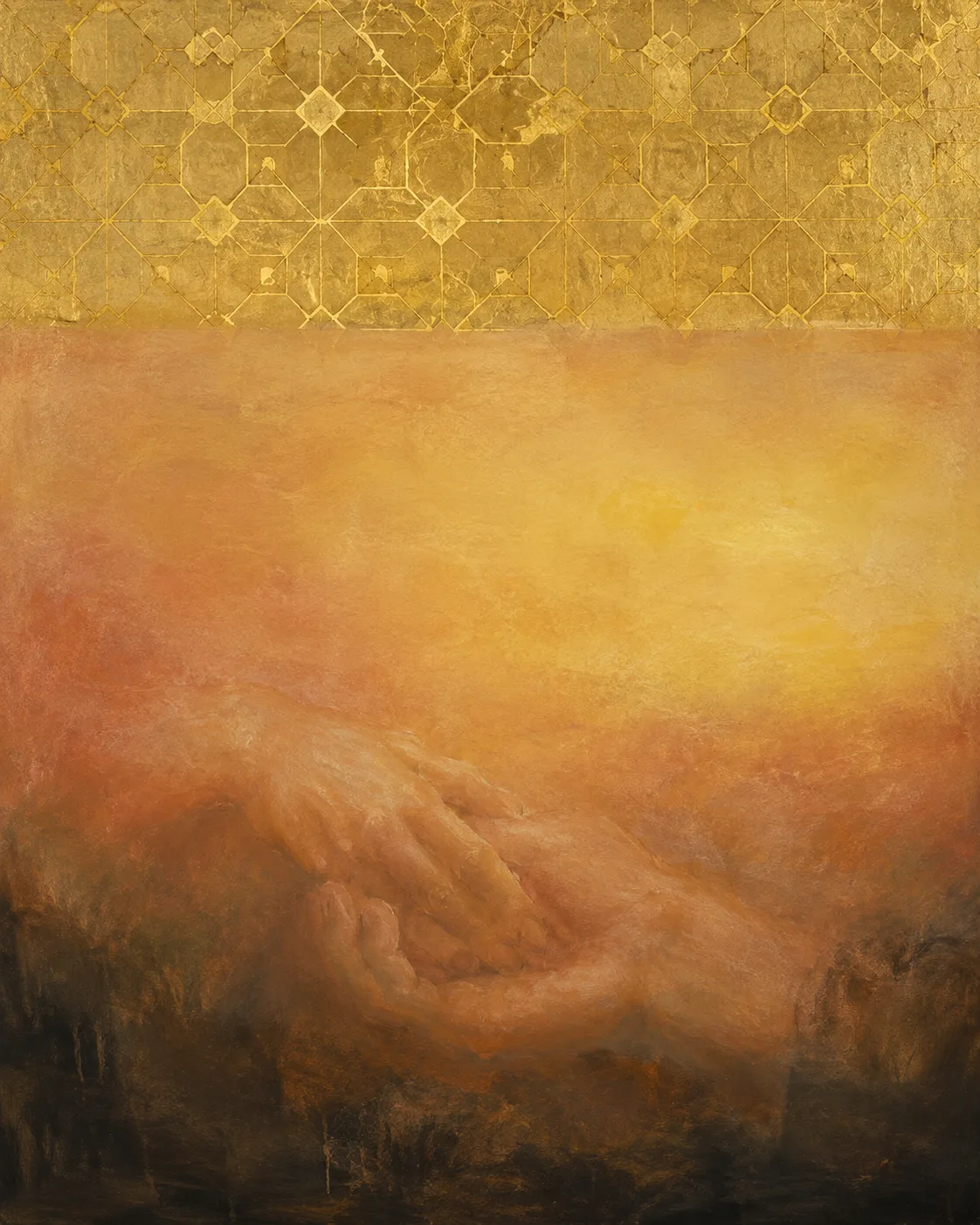
In the months before she died she came to stay with me for a few weeks. She was weak by then and her mobility was limited, so I sat with her for hours. Sometimes I just sat beside her, working on my computer while she lay in bed next to me, and nothing was said because nothing needed to be. Other times we talked. Childhood stories, love, independence, feminism, which is not a subject I ever expected to be discussing with my mother, and on which she turned out to hold rather more settled views than I did.
I got to hold her hand more than I had across my fifty plus years of life on this earth. I got to embrace her and hold her and even lift her when she needed it. Sometimes I was patient and loving. Sometimes I was not. She held all of it with the grace she had carried her whole life.
So when I looked back at the relationship at the end, there was not a single regret. Nothing I wished I had said to her, because it had all been put into words and exchanged. The rest was conveyed through touch. Nothing I wished I had had the chance to do for her. Her last days were made as comfortable as we could manage and she went full-spirited, in death as in life.
Which brings me to the other story my mind has been telling. The one about her last act of benevolence.
It goes like this. She grew weak enough to need me, and in needing me she handed over the very thing I would otherwise have spent the rest of my life wishing for. A few unhurried weeks. Her hand in mine. No unfinished business. A parting gift, arranged with the same quiet competence she brought to arranging everything else.
It is a lovely story. I notice that I want it very badly to be true.
I have spent years now learning to catch the mind in the act of construction, and it does not stop being a construction because the subject is your dead mother. Her body failed. That much I can verify. Everything stacked on top of it, the benevolence, the design, the gift, is scaffolding the mind put up afterwards and in a hurry, because the alternative was a sequence of events with no shape to them at all.
So I do not know whether those weeks were a gift she gave me or a meaning I went back and fitted over them. I cannot ask her, which is rather the point.
What I have realised is this. We are going to tell a story either way, since the mind does not offer an abstention option. Given that, I have chosen the one that lets me hold her hand and hold the friction at the same time. It may well be a kindness I manufactured and then accepted from myself. I find I can live with that.
The witness is still there. It watched me write this, taking its notes, mildly interested. I have stopped expecting it to leave. Some mornings I still cannot bring her face up clearly and it frightens me, and then by the afternoon I hear her in something I have said to my own family, and there she is. I am going to be fine, exactly as I kept promising myself in that waiting room. What I would give, still, is one more afternoon beside that bed, to ask her whether she knew what she was handing me.